Hey Rama: Building a Voice-First Offline Learning Companion on Raspberry Pi 5
A complete roadmap and offline AI framework guide to build 'Hey Rama' - a private, voice-based learning system for children using Raspberry Pi 5, Ollama, Qdrant, and LangChain.
Vision
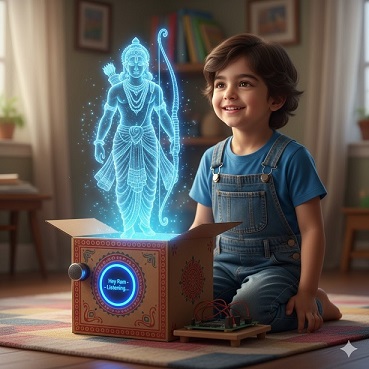
- Hey Rama is a voice-first, completely offline learning system built on Raspberry Pi 5 (16 GB).
- It teaches a child topics like Ramayana, Mahabharata, Maths, Logic, Nature, Space, and Storytelling using a local Large Language Model (LLM), speech recognition, and agentic reasoning.
- The project helps a child explore knowledge safely, while giving a product manager like myself- a hands-on builder experience with real-world AI orchestration.
Feature Roadmap and User Stories
Each feature is ordered for incremental build-out with clear objectives and finalized tool references.
1. System Setup and Environment
- Objective: Prepare a stable, secure platform for offline AI workloads.
- Technologies: Raspberry Pi OS 64-bit, Linux, Python, Docker
User Stories
- Prepare boot media, power supply, and cooling.
- Install Raspberry Pi OS (Bookworm 64-bit).
- Configure static IP, SSH, and firewall (UFW).
- Create
/datadirectories for models, corpus, and logs. - Validate system health under load.
2. LLM Runtime Setup
- Objective: Enable local LLM inference through Ollama.
- Technologies: Ollama, GGUF 7B (Llama 3.1 or Mistral), systemd
User Stories
- Install Ollama service.
- Pull 7B instruction-tuned model (quantized q5_k_m).
- Add smaller fallback model (3B) for quick responses.
- Verify response times <8 seconds.
3. Knowledge Base and RAG Pipeline
- Objective: Build an offline retriever for factual and narrative content.
- Technologies: Qdrant, Sentence Transformers, Python
User Stories
- Install Qdrant vector database.
- Create collections for each topic: Ramayana, Mahabharata, Maths, Logic, Stories, Nature, Space.
- Use local embeddings (
all-MiniLM-L6-v2). - Ingest chunked, tagged content into Qdrant.
- Validate retrieval accuracy, switch to hybrid heirarchical RAG is accuracy is low.
4. Voice Input and Output
- Objective: Enable hands-free, real-time interaction.
- Technologies: openWakeWord, Whisper.cpp, Piper
User Stories
- Calibrate microphone input.
- Implement Whisper.cpp for offline STT.
- Add wake word “Hey Rama” detection.
- Configure Piper for offline child-friendly TTS.
- Test full speech loop with <2s total latency.
5. Orchestration and Agent Flow
- Objective: Build dynamic flow between input, reasoning, and output.
- Technologies: LangChain (local), REST APIs, JSON flows
User Stories
- LangChain local orchestration.
- Create retrieval-augmented QA chain (RAG).
- Add context memory for smoother multi-turn answers.
- Map intents: storytelling, quiz, knowledge, logic.
- Validate full pipeline: wake → STT → retrieve → LLM → TTS.
6. Topic-Specific Agents
- Objective: Make “Hey Rama” intelligent across multiple learning domains.
- Technologies: LangChain, Qdrant, Ollama
User Stories
- Story Agent - narrates moral and mythological stories.
- Quiz Agent - asks short questions and explains answers.
- Knowledge Agent - answers “why” and “how” questions.
- Each agent retrieves from its domain-specific Qdrant collection.
- Test tone consistency for age 5–8.
7. Safety and Governance
Objective: Keep the system factual, respectful, and child-safe.
Technologies: Guardrails AI (offline), local logging
User Stories
- Apply Guardrails filters on responses for tone and safety.
- Add parental control (time limits and topic access).
- Log all interactions for transparency.
- Validate safe outputs.
8. Monitoring and Maintenance
Objective: Ensure reliability and observability.
Technologies: systemd, journalctl, Glances
User Stories:
- Create systemd units for each service (Ollama, Qdrant, STT, TTS).
- Set up health checks and daily restarts.
- Log CPU/RAM usage and conversation stats.
- Add alerts for service failure.
9. Testing and Demos
Objective: Validate real-life usage.
Sample Scenarios
- “Hey Rama, tell me about Hanuman.”
- “Quiz me on addition up to ten.”
- “Read a story about animals found in Africa.”
- “Why is the sky blue?”
Each should complete end-to-end locally, with clear voice and no external connections.
AI & Agentic Frameworks Planned for Implementation
| Framework | Purpose | Key Learning |
|---|---|---|
| LangChain (Local) | Agent orchestration between Ollama and Qdrant | Chains, retrieval, reasoning |
| RAGAS | Evaluate retrieval accuracy and relevance | RAG metrics, quality scoring |
| Whisper.cpp | Offline speech-to-text | Real-time STT optimization |
| Piper | Offline text-to-speech | Voice synthesis tuning |
| MemGPT | Add persistent memory to sessions | Conversation recall, personalization |
| Guardrails AI (Offline Mode) | Enforce tone and safety | Response filtering, schema validation |
| TruLens (Offline Eval) | Evaluate model helpfulness | Trace and assess reasoning quality |
Learning Areas
| Area | What to Learn? |
|---|---|
| LLM Orchestration | LangChain chains, context flow, structured prompts |
| Retrieval Evaluation | RAGAS, groundedness, recall precision |
| Conversational Memory | MemGPT local context persistence |
| Voice UX | Whisper.cpp latency tuning, Piper tone optimization |
| AI Safety | Guardrails rule definition and validation |
| Agent Evaluation | TruLens metrics and improvement loop |
| System Thinking | Offline-first architecture, reliability design |
A Product Manager’s Perspective
- After over 6 yrs in product management, this project reminded me of what originally drew me to technology- the joy of building something useful from first principles.
- “Hey Rama” isn’t just an AI experiment; it became a full product lifecycle in miniature - discovery, design, development, validation, and iteration - all compressed into a single, tangible artifact.
- Every component decision - Ollama for edge inference, Qdrant for retrieval, LangChain for orchestration, Whisper and Piper for voice - mirrors the same trade-offs faced in enterprise-scale products: performance vs. usability, innovation vs. reliability, and ambition vs. maintainability.
From a PM’s lens, it represents five core learnings:
- Start with a clear outcome - “delight the user” here meant delighting my 5-year-old curious son.
- Design with constraints, not despite them - a 16GB Raspberry Pi forces thoughtful scoping. If you have a 4/8GB one, entire design needs to be mapped out from scratch.
- Prioritize modularity - each addition (LangChain, MemGPT, RAGAS) had to earn its place.
- Measure value, not volume - small, observable wins (a faster answer, a more accurate story) trump over-engineered complexity.
- Close the feedback loop - real-world testing with a curious child is better than any synthetic evaluation metric.
In essence, this project bridges AI system design and human-centered product thinking. It demonstrates that being “AI-ready” as a product manager isn’t about memorizing frameworks- it’s about understanding the why behind each layer of intelligence you introduce.
It’s the same muscle we use in large organizations, just exercised in a sandbox of pure creativity.
A Father’s Perspective
As a father, “Hey Rama” became something deeper - a bridge between my world of technology and my child’s world of imagination.
I am waiting for the day when my 5-year-old says “Hey Rama, tell me about Hanuman” and hearing a gentle, local voice respond- without screens, ads, or distractions - will sure be pretty satisfying!
Every late-night debugging session would be worth it, because it wasn’t just about code or AI- It was about showing my child what curiosity looks like in action - and how we can build our own tools instead of consuming someone else’s.
© 2025 Ujwal Iyer - Reflections of a father and a PM who is learning AI by building, not by watching youtube videos and reels :-).