Building AI for My 5-Year-Old: Designing Curiosity, Not Consumption
How a Dad, who's a Product Manager is learning AI hands-on by building a safe, voice-only LLM companion for his child - blending parenting, product thinking, and technology.
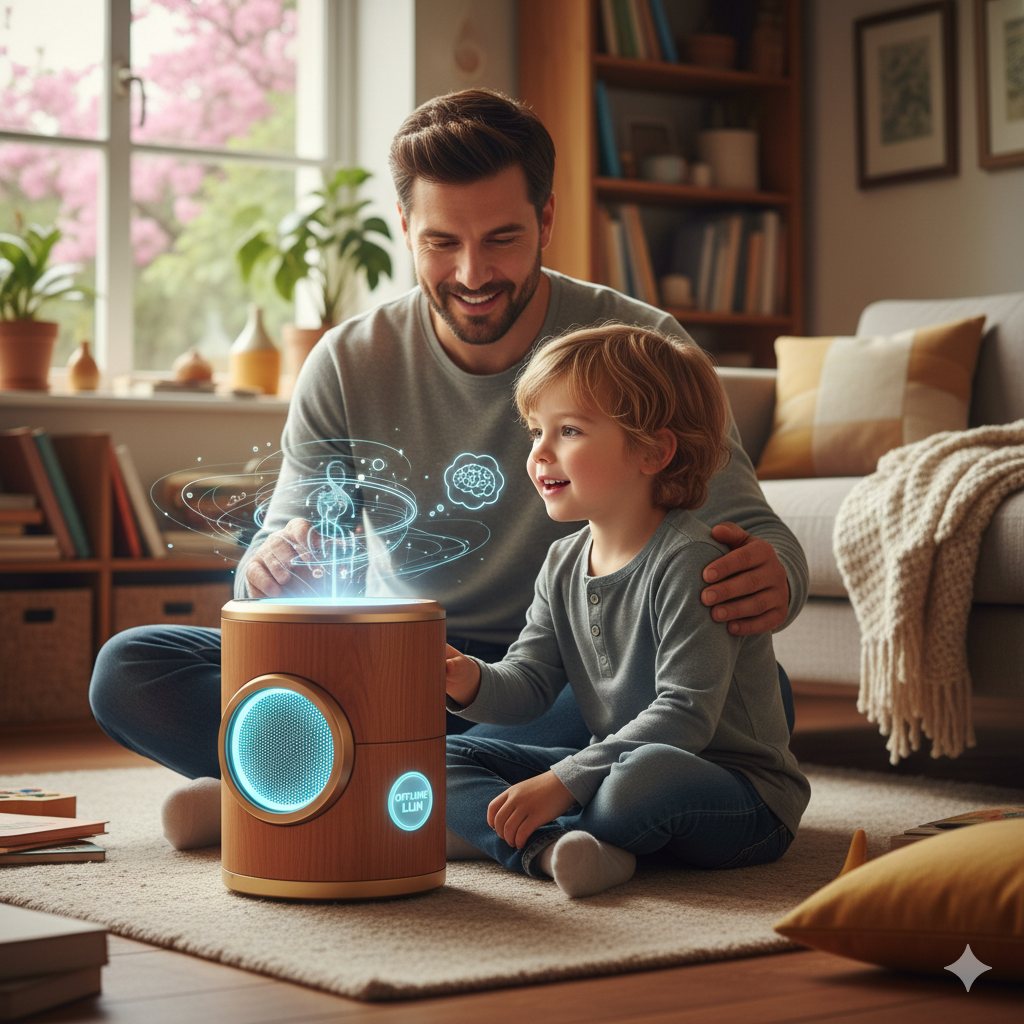
Building AI for My 5-Year-Old: Designing Curiosity, Not Consumption
My 5-year-old is obsessed with questions.
Not the “what’s two plus two” kind - but the ones that stop you mid-scroll.
“Why can’t we see air?” “Why is Hanuman red?” “Why does a gas flame burn blue, not orange like a matchstick?”
Half my evenings are spent switching between ChatGPT tabs and bedtime stories. It made me wonder - if AI can answer my product strategy questions at work, why can’t it nurture his curiosity too?
That’s when it hit me: we build AI to make adults efficient; maybe it’s time I build an AI to make kids wonder.
1. The “Curiosity Persona”: Understanding a 5-Year-Old User
Before jumping into tools or frameworks, I did what any PM would do - built a persona.
Not a B2B buyer or an enterprise admin, but a Curious Explorer aged five.
| Attribute | Description |
|---|---|
| Name | 5 yr old curious toddler |
| Motivation | Understand the world through stories, voices, and patterns |
| Preferred Interface | Voice, facial cues, sound effects, short narratives |
| Attention Span | 2–3 minutes max per topic |
| Cognitive Model | Relates abstract ideas to known visuals (Hanuman = strength, fire = energy) |
| Parental Expectation | Safe, screen-free, emotionally aware experience |
2. Jobs-To-Be-Done for the Toddler
| Job | Current Solution | Pain (1–5) | Gain if Solved (1–5) |
|---|---|---|---|
| Get answers to big “why” questions | Parents or YouTube Kids | 3 | 5 |
| Listen to Itihasa (Ramayana, Mahabharata) stories with meaning | Parents reading books | 2 | 4 |
| Explore science through daily life | Random videos or books | 4 | 5 |
| Feel heard when asking many questions | Adults often tired or busy | 5 | 5 |
So the core Job to Be Done is:
“Help me explore my world through conversation - not content.”
3. Designing for Zero Screen Time
Here’s where most AI tools fail children - they assume visual attention.
But for a 5-year-old, eyes are for imagination, not interfaces.
So, the system must rely purely on voice + presence.
- Wake word model: “Hey Rama, can you tell me about rainbows?”
- TTS engine: A friendly Indian-accented voice that blends warmth and curiosity.
- Sound design: Each response ends with a short hum, like a “thinking” pause - helping the child know it’s listening.
- Emotional pacing: Limit answers to 2–3 sentences. End with a “What do you think?” to spark dialogue.
This isn’t a chatbot; I will try to design it like a co-explorer.
4. Safety Architecture: How to Make AI Safe for Kids
Building for kids isn’t just about “PG-rated” data. It’s about emotional safety and cognitive scaffolding.
a. Guardrails
- Use a local LLM (like Llama 3.1 GGUF) fine-tuned on pre-vetted content - no open internet access.
- Curate a knowledge corpus: Children’s encyclopedia, Amar Chitra Katha, ISRO science explainers, mythology retellings.
- Analyze retrievals from RAG and filter out words/meanings which are not toddler friendly
b. Ethical Filters
- Reinforce the phrase “I don’t know” gracefully. For example:
“That’s a deep question. Maybe we can learn that together tomorrow!”
- Keep tone consistently empathetic, never corrective.
c. Parent Mode
- Mobile dashboard for parents to view:
- Topics explored
- Follow-up questions
- Curiosity trends (what’s peaking this week: “fire,” “planets,” or “Hanuman”)
5. MVP Scope: A Safe AI Story Companion
| Feature | Description | PM Lens |
|---|---|---|
| Voice activation | “Hey Mitra!” trigger using Whisper or Porcupine | Accessibility |
| Story modules | Ramayana, Mahabharata, ISRO discoveries, nature sounds | Engagement |
| Question answering | Short conversational responses via Llama.cpp | Core value |
| Parent dashboard | Topic analytics via n8n workflow | Transparency |
| Offline mode | Runs locally on Raspberry Pi | Safety-first |
North Star Metric:
“Minutes of meaningful conversation per day (vs passive screen time).”
Guardrails:
- Session <10 min per hour
- 100% offline safety compliance
Retention goal:
80% weekly usage consistency by the child (measured via parent logs).
6. The Delight Loop
The delight moment isn’t when it answers correctly.
It’s when it asks back.
“Do you think Hanuman could jump because he was light like air or strong like wind?”
That’s when a child pauses, thinks, and smiles. That’s engagement, not addiction.
That moment becomes viral - not on social media, but across living rooms. Parents talk. Builders notice. And the loop grows.
7. My Learning Journey as a Product Manager
This project isn’t just for my son - it’s a sandbox for me as a product manager.
I’ll be learning AI by building it hands-on, using a Raspberry Pi 5 (16GB) as the playground.
Here’s what I plan to implement and learn through this:
- LLM integration: Running local inference with Llama 3.1 GGUF models.
- Agentic frameworks: Building multi-agent orchestration using LangChain and LangGraph.
- Hierarchical RAG (Retrieval-Augmented Generation): Organizing mythology, science, and nature stories in topic layers.
- Text-to-Speech (TTS): Crafting emotionally warm, kid-friendly voice synthesis.
- Speech-to-Text (STT): Capturing natural child speech and simplifying intent parsing.
- Safety and moderation layer: Filtering and transforming responses for age-appropriateness.
- Edge deployment: Running everything locally for privacy and offline reliability.
- Voice UX testing: Observing how a child’s curiosity shapes the LLM feedback loop.
So there are really three happy personas in this journey:
| Persona | Motivation | Outcome |
|---|---|---|
| The Dad | Sees his child delighted by learning through curiosity, not screens | Pride and purpose |
| The Product Manager | Learns AI deeply by building, debugging, and iterating - not consuming theory | Real mastery |
| The Child | Gets the power of an LLM through his own voice and imagination | Joy and agency |
8. Product Manager’s Reflection
This project taught me something no user research could - curiosity is the most underrated product metric.
In building this, I’m not launching another “AI for kids” app. I’m redesigning how curiosity scales safely in the age of LLMs. If this works, I’ll have built not just a learning companion for my child - but a blueprint for how AI can grow with us, not over us.*
9. What’s Next
I’m building this project from scratch - hardware, data pipeline, orchestration, tools, and voice UX.
The goal is simple:
To make curiosity the most natural interface between a child and AI.
Watch this space - I’ll be sharing each milestone as I build the Kid-Safe AI Companion on Raspberry Pi 5.
The next post in this series will cover: Setup of Raspberry Pi 5
- Ujwal Iyer
Senior Product Manager | SAP Labs | Builder & Dad | Learning AI by Doing